The post Ovato NZ launches full-service support for emerging magazine publishers appeared first on Targeted Media Services Network.
]]>Ovato has launched a new Ovato Publishing Solutions division in response to the exit of Bauer Media in New Zealand and the change this will mean to the country’s magazine publishing sector.
Ovato NZ Managing Director Paul Gardiner said that he believes the Bauer NZ titles will “probably end up in the hands of a number of small to medium-sized publishers and could even see new entrants move into the space”.
“The New Zealand magazine market will be fragmented going forward and there is an opportunity for new and smaller magazine publishers to leverage back-end publishing services by partnering with OPS, maximising efficiencies for their business.”
Paul Gardiner, Managing Director, Ovato NZ
Ovato Publishing Solutions aims to provide a ‘one-stop’ shop of services, including:
- Magazine research and insights
- Advertising representation (print and digital)
- Magazine printing and production
- Circulation and marketing services
- Retail distribution including demand forecasting and allocations
- Retail merchandising and brand activation
- Subscription management and mailhouse services.
Gardiner said that “This full-service model for Magazine publishing is centered around enabling Publishers to do what they do best, which is to create great content, while at the same time being able to tap into a non-competitive shared support network that makes it easy for them to get their content to market and in the hands of consumers”.
Ovato Pubishing Solutions will be headed by Tony Edwards, who is the General Manager of Ovato Retail Distribution.
“We are actively responding to change and anticipated demand in the magazine market. Ovato NZ is the only print, distribution and marketing company that has the ability to offer this total suite of services to provide NZ publishers a cost-effective publishing solution,” Edwards said.
He went on to say “We are excited about what the new NZ magazine market will look like. During COVID-19, even with the reduction in magazine availability due to Bauer’s exit and limited retail, we have seen strong sales in supermarkets. New Zealanders continue to have a strong connection with magazines”.
To learn more, visit the Ovato NZ website.
The post Ovato NZ launches full-service support for emerging magazine publishers appeared first on Targeted Media Services Network.
]]>The post New Scientist’s Jo Adams: data is the beating heart of our business appeared first on Targeted Media Services Network.
]]>As politicians, businesses and commentators vie to see how frequently they can say “unprecedented times”, the COVID-19 outbreak has encouraged people to seek out more academic perspectives.
During the UK’s often venomous altercations over the Brexit referendum, one senior politician declared in a TV interview that the public had “had enough of experts”. Wishful thinking on the government’s part, perhaps, as it’s those experts to whom we’ve turned.
Fielding the important questions about this pandemic, and more, the New Scientist, is a stalwart in the science and technology world.
Founded In the UK as a print magazine in 1956, it launched a digital edition in the pioneering days of 1996, covering tech, health, the environment, space, physics, the mind, and more. The online version features all the print content alongside a wealth of news, opinion and in-depth articles, as well as video and podcasts.

Jo Adams, Marketing Director, spoke to Bibblio CEO Mads Holmen about subscription models, SEO visibility and their lab-like methodical processes for success.
Mads: Hello Jo. Let’s jump in and find out who the New Scientist’s target audience is.
Jo: Sure! We’re naturally targeted towards the scientific community, along with business decision-makers, purchasers and the general public. A third of readers are based in the US, followed by the UK, Australia and the rest of the world. They tend to be educated, older and affluent, but our offering isn’t exclusionary and appeals to all who have an interest in science and technology.
M: What different types of content do you offer?
J: We have written news, comment, analysis and in-depth reporting, as you’d expect, which runs across print, online and app. We have weekly podcasts as well as video, filmed mainly at our popular events series, such as the multi-award-winning science festival, New Scientist Live. Our events portfolio is quite extensive, with masterclasses, evening events and discovery tours also drawing the crowds. In addition, we help individuals through New Scientist Jobs, giving them an opportunity to connect and advance their careers across science, tech, engineering and medicine.
M: How large is the New Scientist and your audience?
J: We’ve just under 100 staff members with a main office in London’s Covent Garden, and a small team in Boston and Sydney. We’re seeing 10.4 million online page views each month, 6.4 million unique users, mostly via desktop, spending averages of four minutes on-page. There are also 132,000 app users, 500,000 email newsletter subscribers and 400,000 jobseekers on our careers platform.
M: You’re established but are continuing to grow impressively – what has been the secret sauce?
J: I believe it comes down to expert file management, data-driven insight and a test-and-learn mentality. We leverage them in singleminded service of three key objectives:
- driving volume, yield and revenue through optimising existing audience and channels;
- developing new audience segments; and,
- fostering company-wide collaboration, to develop new products and campaigns across the business.
M: That’s a sound methodology. How do you prioritize developing these new audience segments whilst engaging your existing users deeper?
J: With equal focus. We have a Head of Campaign Management and a Head of Customer Experience. One focuses on acquisition and the other retention, but they both work together, and with the wider business, on engagement, because engagement is equally important for both new and existing customers.

M: How are you retaining your audiences?
J: With excellent content; 50 per cent of our resource is editorial, we invest in editorial content across multiple platforms to engage and delight our audiences.
M: What are the key audience metrics you define success by?
J: Along with the obvious: Subscriber volume, revenue, yield, retention rates, cost-per-acquisition, etc. we are also developing an engagement metric across tenure based on frequency, recency, volume and dwell. We also closely monitor first-year churn.
M: Define what SEO means to you. Are we talking keywords, page speed, engagement?
J: All of the above, but also SEO is about discovery; it’s essential you’re on the first page of search engine results, as this is where you will be discovered. Last year we were in the Sistrix Top 100 SEO Winners list, reaching 16th with a 181 per cent increase in search visibility.
M: What’s your social media strategy, and how important is it for you to be present on those platforms?
J: Hugely important, we have a dedicated social media team headed up by our fabulous social media editor. We have over 8 million followers across Facebook, Twitter, Instagram and YouTube. Right now it’s all about video.
M: Would you describe them as data-driven?
J: Absolutely! Data is the beating heart of our business. As I mentioned, the trio of expert file management, data-driven insight and a test-and-learn mentality works very well in reaching our three key objectives.
M: Could you shed a bit of light on your revenue model?
J: We are a subscription business with a hard paywall, but back issues prior to 1989 are free to read online. We also run advertising site-wide, with further revenues from our print editions, events and sponsorship.
M: What’s your fastest growing area?
J: Global subscriptions. There is a growing demand for trusted, authoritative content and we are seeing this through our international growth. We posted a 3.29 per cent increase in print circulation (measured by ABC), which was the first increase in some 12 years.
M: Why do you think your model has been successful?
J: We use the data to guide our decision making, and our mantra is “test and learn”. This focuses us on delivering what our customers want, not what we think they want.
M. From your own journey, what do you think other vertical publishers could learn?
J: Let the data guide you. Put data at the heart of your business and learn to ask the right questions, and the rest will follow.
To view the original interview, visit Bibblio’s website.
The post New Scientist’s Jo Adams: data is the beating heart of our business appeared first on Targeted Media Services Network.
]]>The post AFAR Audience Development Director: let the data tell you if your ideas were right appeared first on Targeted Media Services Network.
]]>Travel has always held a special place in the publishing world, with businesses and individuals alike sharing their experiences and recommendations for leaving their environs and exploring. Bibblio caught up with AFAR Director of Audience Development Anni Cuccinello to find out how this leading experiential travel company is making an impact in this space.

Experiential travel, for those unfamiliar, is a form of tourism where you actively immerse yourself in the place you’re visiting, meaningfully engaging with the culture, rather than spending a cursory hour in the Old Town before retreating to the hotel pool.
Founded in the United States in 2009, AFAR magazine began life in print format but now has digital versions alongside, with a depth and style that has global appeal. The company also operates a non-profit foundation providing scholarships for educational journeys for students.
Anni spoke to Bibblio CEO Mads Holmen about listening to your data, optimizing for search and building loyalty.
Mads: What different types of content are you offering these avid travelers?
Anni: Our editorial team offers inspirational and actionable content for every stage of travel planning – from pieces meant to inspire a reader’s next trip to tactical guides that ensure travelers have all of the information they need once their feet are on the ground in their destination.
M: How big is this team and what size of audience are you helping?
A: We have over 60 employees who are mostly split between our NYC and San Francisco offices. In terms of audience, we see 1.3 million unique visitors per month on AFAR.com and a circulation of over 1.2 million with our print magazine, AFAR.
M: You’ve grown impressively – what has been the secret sauce?
A: AFAR just celebrated its 10th anniversary and in that time we’ve developed a loyal following of the world’s best travelers who see us as an indispensable resource for experiential travel. Yet there are many people who are just finding out about us. In the past two years we’ve doubled our digital audience.
Focusing on optimising our content for search has been a significant part of that success, but we have also seen large gains from social and Flipboard. Our newsletter audience has always been a major traffic driver and we are constantly testing what our audience responds to.
We’ve launched two new newsletters in the past year with the goal of showcasing our editorial point of view a bit more than our daily content round up allows.
We brought on a new digital editorial director in 2019 who has been fantastic at pinpointing new types of content that resonate across all of these channels.
M: How do you prioritise attracting new audiences vs. engaging existing users deeper?
A: It’s definitely not an either/or. Attracting new audiences is critical, but if they aren’t enjoying their experience once they land on our site, the churn would be too much to keep up with. And as a brand that isn’t necessarily known by all, we must ensure that they understand how AFAR stands out from the average travel publication – that we focus on helping readers plan trips that let them understand the heart of a destination and have experiences that stay with them for life.

M: How are you retaining your audiences?
A: We speak to readers differently depending on how they’ve arrived on our site. We promote our award-winning newsletters as well as our incredibly inspiring social accounts to keep readers engaged with our brand even when they aren’t on our site.
We also encourage word of mouth sharing of our brand – there is no better way to build loyalty than to have our readers share why they love us. That starts with a commitment to quality journalism and a unique point of view.
M: Define what SEO means to you these days. Are we talking keywords, page speed, engagement?
A: Certainly all of that, but also content length, inclusion of long-tail search terms, backlinks and more. It’s a more competitive space than ever – the rise of zero-click searches (where a user never leaves a Google-owned property) has gotten so high that even the US Congress is inquiring about it.
Trying to beat Google at their own game is hard, so we always consider competition level when prioritising content. And EVERY piece is optimised for SEO – our editorial team has been wonderful about embracing that as part of their daily workflow and it has paid off. Our search traffic increased 70 per cent last year.
M: What’s your social media strategy, and how important is it for you to be present on those platforms?
A: We have a lean social team, but we still managed to double our social traffic in 2019, even when facing challenging algorithm changes. Our social editor works closely with our editorial team to help with social-friendly content and also optimize headlines for social shares.
We also prioritise where the team’s time is spent based on the strongest ROI for us. Instagram, as you can imagine, is huge for us as a travel brand. We spend a lot of time on photo curation and writing captions that are enjoyable to read but also offer smart insights for readers, and we often hear from them about how much they enjoy that.

M: Do you work together with other publications in your vertical?
A: Absolutely. A major part of our success on social has been cross-sharing content with brands that share our values and approach to travel. We’ve seen so much success from it, we’ve started doing more cross-sharing with our newsletter audience.
I also think sharing content from other outlets helps show readers we aren’t landing in their inbox just to get them to click on our content. Our newsletters serve as a resource for all the news avid travelers need.
M: Would you describe your business as data-driven?
A: Nearly every meeting or conversation we have about our growth strategy has some sort of metric attached to it. We develop hypotheses and let the data speak as to whether our ideas were right or not.
M: Could you shed a bit of light on your revenue model?
A: Our revenue mostly comes from advertisers who want to align themselves with our growing brand, but also from sponsored content and affiliate revenue.
M: What’s the best thing you’re bringing into 2020?
A: AFAR has had affiliate revenue deals for a long time, but 2019 was a year of constant experimentation on this front. We tested new types of affiliate content and partnered with new networks to help identify types of products that our readers are most interested in.
We are really excited to take our learnings from last year, where we experienced +270 per cent year-on-year growth in revenue, and apply them to our content plan for 2020.
To view the original interview, visit Bibblio’s website.
The post AFAR Audience Development Director: let the data tell you if your ideas were right appeared first on Targeted Media Services Network.
]]>The post Globally, most publishers look to reader revenue as main future income stream: Reuters appeared first on Targeted Media Services Network.
]]>The Journalism, Media, and Technology Trends and Predictions 2020 report is based on a closed survey completed by 233 senior executives from 32 countries including Australia, and provides insight for the year ahead and aim to identify the most important media trends.
Over half of the survey participants were from a print publishing background (54 per cent), 14 per cent came from digital-born media, and 6 per cent from B2B companies or news agencies.
Nic Newman, Senior Research Associate at the Institute, says “The last 10 years were defined by the twin technological disruptions of mobile and social media, which fragmented attention, undermined advertising-based business models, and weakened the role of journalistic gatekeepers.
“The next decade will be defined by increasing regulation of the internet and attempts to re-establish trust in journalism and a closer connection with audiences. It will also be rocked by the next wave of technological disruption from AI-driven automation, big data, and new visual and voice-based interfaces.”
He says that the “overwhelming mood from this year’s survey is one of quiet determination not to be distracted by the latest innovations but to focus on delivering long-term value for audiences,” while explaining that there is no one path to success, but there is greater confidence that publishing can succeed in a digital age.
Distrust of digital platforms continues
Globally, the report found that the power of digital platforms such as Google and Facebook remains a concern for most publishers, but there are mixed views on regulation. The report found that, overall, publishers don’t want hand-outs from these platforms but would prefer a “level playing field” where they can compete fairly and receive appropriate compensation for the value of their content.
“Publishers remain resentful about what they see as unfair competition from platforms and tech companies. With regulation looming, we’re likely to see publishers pushing their rights harder than for many years.”
Reader revenue will become main income for many publishers
Of the survey respondents, 50 per cent of publishers said that reader revenue will be their main income stream in the future, while 35 per cent think that advertising and reader revenue will be equally as important, and just 14 per cent are planning to rely solely on advertising revenue.
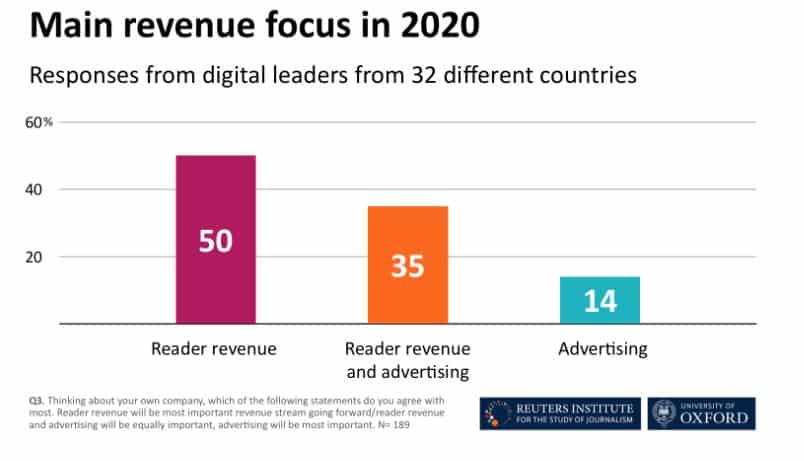
The report found that many European publishers are looking to rely on a variety of premium content, paid subscription or membership models.
However, Newman says that success is not guaranteed: “Growing competition for a limited pool of people prepared to pay for news is likely to be a challenge this year as subscription models mature. Heavy discounting is already widespread and churn rates are likely to become an increasing worry for those that can’t prove consistent value to audiences.”
The report says that monetising audiences will require a deep commitment over time as well as new skills and processes.
At the very least, collecting first-party data – in the form of asking for registration in return for content – will be a key focus for publishers, a likely response to reduced cookie support from leading browsers and tightened privacy regulations in Europe and North America.
There are concerns about the barriers that this will pose for casual newsreaders.
“With more high-quality journalism disappearing behind registration barriers and paywalls, the democratic dangers may also become more apparent in the year ahead. The fear is that serious news consumption will be largely confined to elites who can afford to pay, while the bulk of the population pick up headlines and memes from social media or avoid the news altogether,” the report states.
Podcasting is an important growth area
One of the ways in which those surveyed are looking to solve the engagement of casual newsreaders while moving to pay-walled models is via other accessible formats like events and podcasts.
Over half (53 per cent) of publishers said that podcasting would be important, while others are looking at turning text articles into audio as a way of capitalising on the increase of voice and audio formats.
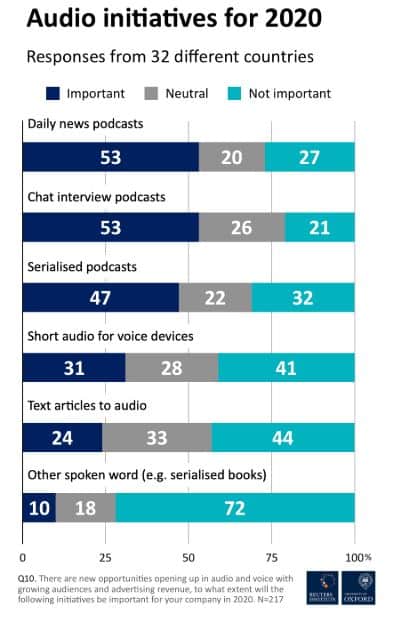
Newman says that podcasting revenue is projected to grow by about 30 per cent a year to reach over $1 billion by 2021 in the US, while revenues elsewhere have been slower to build despite the clear audience opportunity particularly amongst younger audiences.
Reuters predicts that better headphone technology, such as the AirPod Pro, will give a further boost to audio formats in 2020, in addition ot the continued roll-out of 5G networks around the world enabling faster and more reliable mobile connectivity to access to multimedia content.
But the report states that gaining and keeping attention without compromising on quality (and trust) remains a key challenge within the podcasting format.
Personalisation will be used to distribute online content more effectively
More than 50 per cent of survey respondents, mainly news organisations, said that AI will be important in 2020 to ensure the right content is being delivered to their audiences. Types of AI being considered include:
- Creating better article recommendations (over 50 per cent of respondents)
- Commercial uses such as using AI to target potential subscribers and optimise paywalls (47 per cent)
- AI-assisted subbing or tagging to drive greater efficiency in the editorial team (39 per cent)
- Newsgathering (16 per cent).
The report also predicts that transcription, automated translation, and speech-to-text text-to-speech services will be some of the first AI-driven technologies to reach mass adoption this year, opening up new frontiers and opportunities for publishers.
“Against this background, artificial intelligence offers the possibility of more personal and relevant news services, as well as more efficient ways of packaging and distributing content,” the report says.
“But platforms will need to play a role too – especially in helping publishers reach new and diverse audiences. In this regard, the growth of content licensing via the Facebook News tab and Apple News+ is an intriguing development that will be fascinating to watch, despite widespread industry cynicism. For Facebook in particular this initiative will be critical as it looks to win back trust from publishers.”
The full report can be accessed on the Reuters Institute for the Study of Journalism’s website.
The post Globally, most publishers look to reader revenue as main future income stream: Reuters appeared first on Targeted Media Services Network.
]]>The post 12 digital revenue ideas that work appeared first on Targeted Media Services Network.
]]>So what’s working right now in digital for small publishers? Here are 12 digital revenue ideas to grow your online business.
Here’s a short list of some big ideas:
- Segment with presumptive data by studying what visitors to the site are opening.
- Send out an email regarding a new product launch. Take a 3-pronged approach with editorial release/newsletter/website.
- Create a live event specifically for your super-targeted e-newsletter audience(s).
- Sponsored giveaways work great for lead generation. (Hotels, for example, love the lead generation.)
- Buy lists but be careful.
- Consider re-targeting, hire a digital agency.
- Geo-fence your competitors.
- Does your website revenue average between 10-17 per cent? It should. Now shoot for 25 or 30 per cent!
- Offer exclusive positions on your website and/or banners, limit to 5 max.
- Allow an advertiser to pay to “own” your site for an entire day.
- Regularly audit SEO on the back-end for effectiveness. (Spyfu.com is a good tool.)
- Pair your digital salespeople with your print sales. They can learn so much from each other.
So try one or all 12 of these digital revenue ideas and keep testing out what works best for your niche audience.
P.S. We asked the CEO’s of small B2B’s if any were giving up on print. The answer was a unified, resounding “No Way!” You read it here – publishers are passionate about both their digital AND print products.
2020 Super Niche Media Event registration is open
Headed to the States? Just for niche audience publishers, Super Niche is designed to educate, inspire and connect niche publishers to drive revenue and grow their brand.
The event includes publisher, event, audience development, and ad sales strategies and immediately actionable tactics. Super useful – super fun!
The event will be held from 23-25 March 2020 in San Antonio, Texas, US.
For more information, visit the Super Niche event website.
The post 12 digital revenue ideas that work appeared first on Targeted Media Services Network.
]]>The post How magazine publishers can change their culture to innovate against digital disruption appeared first on Targeted Media Services Network.
]]>The whitepaper, titled Innovation in publishing: how successful publishers embrace and harness innovation for success, the two companies highlight innovative approaches that print publishers have made that “blur the lines between print and digital to offer a richer experience” for the audience.
The whitepaper aims to address:
- What does good innovation look like for businesses large and small?
- How have approaches to innovation changed?
- How can publishers continue to innovate in an increasingly competitive landscape?
The paper explains that the publishers that have been most successful with innovation are those that have taken a measured, strategic approach, rather than innovation “for the sake of it”.
Author of the annual FIPP Innovation in Media World Report John Wilpers says in the whitepaper: “Companies are asking, ‘what can we stop doing that is taking up much-needed resource without delivering return on investment, to free up time to pursue one or two things that we know will work for our business and help us thrive in the market?’”
He says that there are generally two approaches to innovation within magazine publishers:
- Establishing an ‘innovation culture’ across the company so that all staff have a responsibility and opportunity to drive innovation
- The creation of dedicated teams to take on the responsibility for innovation across the company.
Involving all staff and embracing failure
Wilpers recommends making innovation open to everyone – from a secretary to a writer or a senior board member. “Anyone can pitch an idea and, if it’s accepted, they get pulled out of their regular tasks to work on that project for a period of time…It works because it says to people ‘we’re not asking you to do this on your own time or without compensation’ – it’s open to everybody and it is a call to action for everyone to be innovative.”
The whitepaper includes an interview from Lucy Kueng, Professor and expert on strategy, innovation and leadership at the Reuters Institute of Journalism, Oxford University, who explains that the cultural shift to focus on innovation can be a challenge.
She explains that how companies handle failure is central to innovative success: if failure is seen to damage career prospects within an organisation, attitudes toward innovation are likely to be more rigid. She recommends being clear about what an innovative project is, e.g. labelling a project as a ‘pilot’ where learning and insight is promoted as the most important outcome for the company means failure becomes a “non issue”.
“Getting the culture to be more innovative is very hard and you’ve really got to address some of the very tough sinews across the organisation. Trials, experiments and piloting can really help, especially if there is an open sharing of findings and even more so if those involved are seen to have benefitted from their involvement – in terms of their credibility inside the organisation or profile outside it.
“That can send a powerful message to the wider organisation that innovation and change are positive things. But changing the cultural DNA of an organisation takes time. It’s always worth trying to do but it always takes longer than you think.”
Lucy Kueng, Professor and expert on strategy, innovation and leadership at the Reuters Institute of Journalism, Oxford University
“Moreover, a lot of organisations have an awful lot of creativity in the middle and lower layers that is having a problem finding a voice,” says Kueng.
“So part of the challenge is to cut the sinews and put systems and structures in place so that talent can deliver what it can. Strategic projects and cross disciplinary teams are perfect for this. They also help bind that talent to the organisation. And as we have all learned, millennial talent can be hard to hold on to, but is motivated by the opportunity to learn, to develop, to work on key issues.”
Innovate the small things, everyday
Mittmedia Chief Digital Officer Robin Govik is quoted in the whitepaper: “Innovation is part of our daily work”.
Mittmedia is a Swedish digital news platform that evolved from a traditional newspaper publisher. According to Govik, its innovation has been driven largely by user behaviour.
“While we operate in a competitive market – where there is a lot of disruption and a rapid pace of change – the drive to innovate comes from the end-user experience rather than from trying to protect our position. We look at the users’ needs and their behavioural shifts and use those as the basis for innovation.”
Govik says that the best approach to innovate is to plan, research, have a clear goal and let staff know that everyone is expected to innovate. Clear business goals should include:
- Where does the company want to go?
- What progress is needed?
- What is the timeframe to get there?
Govik highlights that innovation does not always have to be about large projects. It can also be about small ways to improve the efficiency of existing systems and processes.
“It’s the iterative approach rather than the ‘big project’ approach, where we won’t see our return on investment for three years. We need a return on investment almost immediately. You still have to have the infrastructure in place – but not every innovation has to be a massive investment.”
“The success of an innovation project isn’t always just about the end outcome or indeed the final result. You can learn valuable lessons along the way and achieve things that, although they were not really the final objective, still help your business grow and improve. That’s a cultural thing as well,” he says.
The Innovation in publishing: how successful publishers embrace and harness innovation for success whitepaper is available for download here.
The post How magazine publishers can change their culture to innovate against digital disruption appeared first on Targeted Media Services Network.
]]>The post How B2B publisher Aspermont calculates million dollar lifetime subscription value appeared first on Targeted Media Services Network.
]]>Headquartered in the UK, Aspermont publishes for the mining, agriculture, energy and technology sectors, and has offices in Australia, UK, Brazil, North America and the Philippines. In recent years, the company, which has a market capitalisation of $23 million, transitioned away from traditional print publications to focus on premium subscription-based print and digital content, and events.
The publicly listed company posted its 2019 Q3 year-to-date results yesterday, outlining a 15 per cent growth in revenue, and 20 per cent growth in gross profit compared to the 2018 Q3 YTD figures.
Breaking this down:
- Subscription revenue has increased by 9 per cent
- Event revenue increased by 85 per cent
- Digital ad revenue increased by 6 per cent
- Print ad revenue decreased by 2 per cent.
How is the $45.5 million subscriber lifetime value calculated?
The investor report states that as at June 2019, the number of subscriptions across Aspermont’s brands totalled 8,218 at an average value per unit of $908, providing Aspermont an annual contracted subscription value of $7.4 million.
Subscribers are listed as retaining their subscriptions for 6.1 years (calculated by 1/churn rate). Aspermont has multiplied the years of retention by $7.4 million to achieve the $45.5 million subscriber lifetime value.
However, Aspermont also states that the renewal rate of subscriptions is 84 per cent. Taking this into account, the lifetime value of Aspermont’s subscriptions is reduced to $37.9 million. Still an amazing result.
Subscription usage stats
Aspermont’s investor report states that digital users across its subscription products now exceeds 2.2 million (defined as users who initiated at least one web session over the 12 months to end June 2019), and over 5.2 million sessions.
How has Aspermont’s revenue diversified over time?
For the FY17, Aspermont reported that its $11.5 million revenue was achieved largely from traditional revenue sources:
- 47 per cent in traditional advertising
- 41 per cent from subscription revenue
- 8 per cent from its content marketing arm
- 1 per cent from job listings
- 1 per cent from research business.
In FY19, the company is predicting that it will achieve $16.6 million revenue from increasingly diversified sources:
- 22 per cent in traditional advertising
- 38 per cent from subscription revenue
- 19 per cent from content marketing (driven by the recent launch of its content agency, Content Works)
- 17 per cent from events
- 3 per cent from its research business
- 1 per cent from jobs.
Aspermont will also look into developing lead generation sponsored content, and training and education opportunities over this time.
What’s next?
Over the next five years, it expects high revenue growth in events, research business, lead generation and content marketing services. It also plans on launching “very high value” subscription products in data services across its sectors.
To view an interactive timeline of Aspermont’s product development since 2000, visit Aspermont’s website.
The post How B2B publisher Aspermont calculates million dollar lifetime subscription value appeared first on Targeted Media Services Network.
]]>The post What we’re reading: using data, diversifying, and looking regional appeared first on Targeted Media Services Network.
]]>Folio: How publishers are using data to transform their marketing operations
This is a great article that explains how US-based publishers are using their reader data to inform content production, boost subscriptions, and enhance advertising on their websites. The article includes case studies from publishers that are classed as ‘niche’ in the US – but have significantly more subscribers and web traffic than small publishers in Australia.
Key takeaway: make sure all your user, subscriber and advertiser data is housed in one, unified system.
What’s New in Publishing: Active Interest Media: Poster child for magazine brand diversification
Active Interest Media (AIM) is a US special interest publisher has been in the news recently for purchasing 14 titles from F+W Media, a US publisher who filed for bankruptcy and auctioned 50 magazine titles earlier in 2019. Here, What’s New in Publishing interviews AIM President and CEO Andy Clurman about attributes of successful publishers, how AIM plans to revitalise the F+W brands, and the challenges ahead.
Key takeaway: diversification is good. Events and memberships are key growth areas for AIM.
Mumbrella: How councils are future-proofing themselves against shrinking regional media
On Australian soil, Mumbrella published about the effect regional newspaper closures has had on small towns and councils. No options for local reporting and independent journalism has led some councils to create their own news websites to keep their constituents informed. And some PR companies are starting to get in on the game.
Key question: can niche or custom magazine publishers evolve the regional news model to take advantage of the gap in the market? Australia is seeing a rise in lifestyle regional titles and independent journalists reporting on regional matters, perhaps news is the next step.
The post What we’re reading: using data, diversifying, and looking regional appeared first on Targeted Media Services Network.
]]>The post What is the Niche Publishing Network? appeared first on Targeted Media Services Network.
]]>It’s something that has been on my mind for a long time.
Having worked across a number of roles in the B2B publishing space, I was always on the look-out for ways that I could improve my performance and contribute to the company’s bottom line – whether that was trawling the web for information, connecting with others in the industry, or participating in professional development courses.
And while there is a lot of information out there – it isn’t in the one spot, and it is very rarely targeted specifically to small publishers.
So I thought I’d create a space dedicated to Australia’s niche publishing community.
The aim of the Niche Publishing Network is to celebrate niche publishers, provide the information needed to deliver the best possible service to subscribers and clients, and provide a platform where publishers and their teams can connect.
I’ll be sourcing practical and thought-provoking content to help editorial, sales, design, marketing, operations, audience and business development teams. This will be in the form of news articles, practical guides, interviews, and opinion pieces sourced from across the industry.
As the Niche Publishing Network’s journey unfolds, I’ll also be experimenting with different marketing and digital publishing techniques – and I plan on sharing the results with you.
But to do this, I need your help. I’d like you to be willing to share your successes and challenges – privately via email or publicly via an opinion piece/s – so that the Niche Publishing Network can provide the most relevant and useful content.
Let’s ignite conversations. Let’s share our knowledge and passion for the industry. Let’s learn from one another and troubleshoot together.
So, tell me: what do you want from a news and information provider dedicated to Australian niche publishers?
Provide your feedback in the comments below, or send me an email at nichepublishers.com.au
I can’t wait to hear your feedback.
Editor and Founder
The post What is the Niche Publishing Network? appeared first on Targeted Media Services Network.
]]>The post Carl Landau sells popular niche publishing services and events company; highlights top M&A tips appeared first on Targeted Media Services Network.
]]>Niche Media runs events dedicated to helping niche magazine publishers generate new and additional revenue, and has attracted a number of Australian delegates over its years of operation. Its events include the Super Niche Media Event and the Niche B2B CEO Summit.
Second Street provides online audience engagement and interactive content platforms for media companies including contesting, quizzes, ballots, polls, surveys, email, and data profiling. The company serves more than 3,500 media companies across North America and the EU including print, television, radio, magazines, and online-only outlets.
In a statement, Second Street said that the acquisition further expands its role as a “disseminator of best practices in media revenue and audience engagement”. The company currently offers numerous resources including the Second Street Lab, Summit, sales workshops, webinars, and playbooks to complement its audience engagement software platform.
Second Street’s said its main goal with the acquisition is to help Niche Media maintain and grow. Under the deal, Niche Media will remain its own independent entity. Further terms of the deal have not been disclosed.
“I have been an attendee and fan of Niche events for over a decade,” said Second Street Co-Founder Matt Coen. “We think very highly of the Niche portfolio of events and the Niche community that Carl Landau has built over nearly 20 years. We’re privileged to become stewards of this great resource to the industry and delighted to have the opportunity to work with the Niche team.”
Niche Media head Carl Landau will remain at Niche Media, along with Vice President of Marketing and Programs Kristi Dougherty. Landau said “I’m super excited to be part of Second Street Media. I’ve known Matt Coen for over 10 years, and admire what he and co-founder Doug Villhard have built.
“It was critical to find the right home for the Niche brand, and the big winners are going to be our niche publishers,” said Landau. “Second Street has the resources and expertise to develop incredible content, tools, and events to help them generate more online revenue and grow their audiences.”
Niche Media publishes top tips for M&A
Following the announcement of Second Street’s acquisition, Niche Media published two articles on merger and acquisition tips, including expert insight from Andy Clurman, CEO and President of Active Interest Media (a US based publishing house with more than 50 print and digital brands), and John McGovern, CEO and Owner of Grimes, McGovern & Associates (a US-based merger and acquisitions advisory firm).
Niche Media recommends that, before going to market, publishers should have an understanding of what buyers are looking for in media companies, how to correctly value your company, and how to achieve the figures you need to buy or sell.
“If you are not planning an exit for several years, invest in a unified audience database that captures all behaviour from which website pages visited to which booths visited at events.”
John McGovern, CEO and Owner of Grimes, McGovern & Associates
Clurman told Niche Media that potential buyers are looking for “repeatable, scalable revenue; consistent history of growth and profitability; diversification around audience with diminishing reliance on print”.
McGovern agreed “…diversify, diversify, diversify. Publishers are swimming upstream with respect to print multiples. If you are not planning an exit for several years, invest in a unified audience database that captures all behaviour from which website pages visited to which booths visited at events.”
“Try to come up with a contribution by revenue type. This requires precision analysis of direct costs and overhead/shared costs…Then we can build a proper valuation estimate by applying higher multiples to growing, more profitable parts of the business – like events, subscription, some digital.”
Clurman also shared that introducing inexperienced staff and advisors into the deal, and changing the terms of the deal “without major provocation” will likely affect a seller’s ability to close the deal, in addition to not following discrete due diligence, planning, and adhering to a timeline that works for both parties.
Niche Media’s two articles on mergers and acquisitions can be accessed here.
Niche Media runs CEO Summits that cover topics such as dealing with mergers and acquisitions. For more information on Niche Media’s events, visit the CEO Summit page here.
The post Carl Landau sells popular niche publishing services and events company; highlights top M&A tips appeared first on Targeted Media Services Network.
]]>